
Stronger laser for melasma? When it can make pigmentation darker
"Will a stronger laser clear my melasma faster?" "It seems darker since treatment." "Does that mean the treatment failed?"
These are questions that arise at the most worrying point during melasma treatment.
To be frank, melasma can become darker when treated too aggressively. There can also genuinely be a period during treatment when it looks temporarily darker. If worry leads you to change clinics at that point, the process starts over.
I explain this period at the first consultation. Without advance notice, patients may understandably think something has gone wrong.

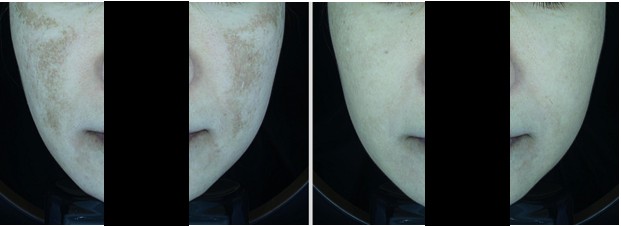
- These before-and-after photographs were taken with the patient's consent under the same environment and conditions, without additional retouching.
- All skin procedures involve individual variation. Depending on skin condition, adverse effects may include redness, pigmentation, inflammation and burns.
- Filler procedures may cause adverse effects including allergic reactions, muscle paralysis, necrosis and blindness.
Why shouldn't melasma be treated aggressively?
Some people ask, "Won't increasing the energy clear it faster?" In melasma, the opposite is often true. At the root are melanocytes, the cells that manufacture pigment. They respond sensitively to ultraviolet exposure, hormones and heat stimulation, continuing to produce pigment. Excessive laser energy can itself become a thermal stimulus. The melasma may appear lighter immediately afterward, but stimulated melanocytes can release pigment again, making it darker than before several weeks later. In rare cases, loss of pigment can also remain. Melasma is less like a switch you press off and more like an alarm that becomes more sensitive the more it is disturbed. Toning for melasma is therefore usually performed with low energy over multiple sessions spaced 2–4 weeks apart. Rather than trying to remove everything at once, gradually reducing it without setting off the alarm offers a way to seek improvement while limiting the burden of recurrence. The more a treatment emphasizes quick promises, the more you should ask whether that speed could be stimulating your melanocytes.
How do we choose the wavelength and energy?
I am often asked, "Isn't having a good device enough?" My answer is that the device is only half the equation; settings are the other half. Melasma pigment may be superficial in the epidermis or extend more deeply toward the dermis. The appropriate wavelength changes with the depth being targeted, and even at the same wavelength, energy and mode change the burden on the skin. I use PicoWay, a picosecond laser, for pigment treatment. It breaks pigment into small fragments using extremely brief pulses measured in trillionths of a second, allowing treatment with relatively less thermal burden than nanosecond devices. However, a picosecond device does not mean energy can be increased without limit. If you are considering melasma treatment in Cheongdam, I recommend asking how wavelength and energy will be selected for your skin rather than comparing device names alone. A specific explanation is more likely to reflect a considered treatment plan.

Why should we read the response to the previous session?
The third criterion is the skin's response. If you ask, "Isn't toning done with the same settings every time?", I would answer that melasma is exactly the condition in which settings should not be mechanically repeated. How many days did redness last after the previous session? In what direction did the color change? Did flaking or dryness increase? These responses guide the wavelength, energy and interval of the next session. Repeatedly adding the same toning without reading the response can lead to stalled improvement, or to recurrence when irritation overwhelms a weakened barrier. If the barrier seems impaired, I may extend the toning interval to 3–4 weeks or longer, or first support the baseline condition with skin boosters and skincare before resuming the laser. Ultimately, I believe the key tool in melasma treatment is not the laser, but the eye that remembers the previous response and reflects it in the next settings.
How we proceed
I approach melasma with triple toning, redesigning the combination of wavelengths and modes at every session even when using the same PicoWay. This method has meaning when the person who assessed the last response also plans the next session. At LUNN Clinic, I am the sole treating doctor and personally continue from consultation through treatment and aftercare. I determine the next settings using not only records but also my own recollection and examination of the previous skin condition. If you are comparing clinics after searching for pico toning in Apgujeong, check whether the practitioner changes between sessions and who follows the responses over time. All care takes place in private rooms. We are a one-minute walk from Exit 4 of Apgujeong Rodeo Station, making it easier to maintain session intervals.
Consistency, more than intensity, shapes the outcome of melasma laser treatment. A practice that explains from the start that treatment takes time is more honest than one promising definite removal in a short period.
Related column: Ten pico-toning sessions with no change? The real reasons a doctor looks for Related treatment information: Pigmentation and redness


